Why Reliable Power Management is Essential for KNX Automation Systems
Nobody plans a smart home around a power supply. Homeowners get excited about keypads, scenes, and the app on their phone. But every single one of those things depends on a device most people will never see or think about — the box quietly feeding power to the whole home automation system.
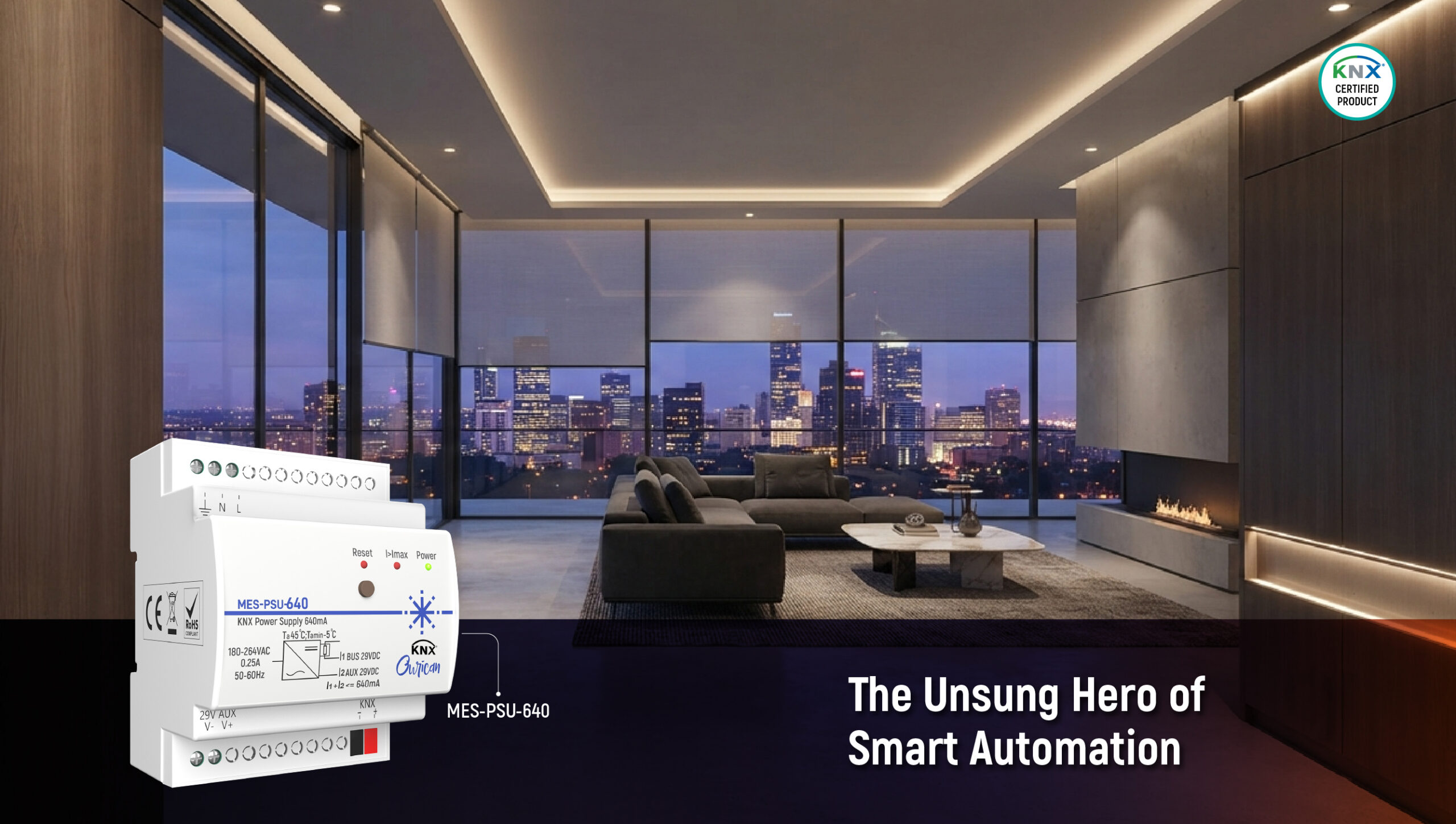
If that box isn’t right, nothing else works properly, no matter how good the rest of the setup is. Ourican’s MES PSU 640 is that box, and it’s worth understanding why it matters more than its size suggests.
What a KNX Power Supply Actually Does
Every device in a KNX home automation system- keypads, fan controllers, sensors, actuators- needs power to run and a way to talk to each other over the same wiring. The power supply is what makes both of those things possible.
Here’s the simplest way to think about it: the power supply feeds the home automation wiring, and that wiring feeds every device connected to it. Take away the power supply, and nothing downstream works, no matter how well-designed the rest of the system is.
The MES PSU 640 takes regular household electricity and converts it into the clean, steady low-voltage power that a KNX system actually needs to run reliably.
Why KNX Runs on Low-Voltage Power in the First Place
This is worth explaining properly, because it’s not just a technical detail; it’s the reason KNX systems are built the way they are.
There’s a clear line between the two systems in a KNX home. Mains electricity, at 230V AC, handles lights, appliances, and sockets. Command wiring, the line keypads, sensors, and controllers use to talk to each other, runs on something far safer: a low-voltage supply of around 29V DC, dedicated entirely to that job.
There are real, practical reasons for this
Safety. Low-voltage wiring carries far less risk than mains-level wiring. That matters a lot in a home automation system, where wiring runs behind walls, through ceilings, and into wall-mounted keypads that people touch with their hands every single day.
Dual-Function Wiring A single KNX bus cable handles two critical tasks simultaneously. It transmits safe, low-voltage DC power alongside digital data packets over a single twisted pair of wires.
Easier, more flexible installation. Because the automation wiring is low-voltage, giving installers more freedom in how they route it through a building.
This is exactly the job the MES PSU 640 is doing: taking the home’s regular electricity supply and converting it into that safe, steady, low voltage power the rest of the KNX system depends on, quietly, and without anyone needing to think about it once it’s installed.
Why This "Boring" Device Actually Matters
Here’s the thing about power supplies in a smart home: you don’t notice them until something’s gone wrong. A weak or unreliable power supply doesn’t announce itself; it shows up later as devices that occasionally miss commands, keypads that respond slowly, or a section of the home that just behaves oddly for no clear reason.
That’s very different from a broken light switch, which you can see and fix on the spot. A weak power supply hides its problems, often showing up months after a project is finished and handed over.
This is exactly why power planning should happen at the start of a KNX home automation project, not as an afterthought once all the “exciting” devices have already been chosen.
What's Inside the MES PSU 640
The unit is built around a specialised electrical component that makes it properly suited to running a KNX automation system, not just any generic power box. A few other things worth knowing:
Built-in protection: against short circuits, overloads, and voltage spikes
A reset button: that lets an installer restart the whole system directly from the power supply — genuinely useful during setup
Simple LED status lights : a green LED shows normal operation, while a red LED indicates a reset, overload, or short-circuit condition — so anyone checking the panel can tell at a glance whether the system needs attention
Safe, well-isolated design: so the power side and the device side of the system stay properly isolated from each other
Compact panel mounting: so it fits neatly alongside the rest of the automation hardware
Low power use and high efficiency: so it runs quietly in the background without wasting energy
None of this sounds exciting on a feature list. But it’s exactly the kind of detail an installer is grateful for during setup and even more grateful for years later, if something ever needs troubleshooting.
Where the Details Actually Matter
In a premium home, with keypads, lighting, and fan controllers all sharing the same system, a strong, correctly sized power supply is what keeps everything running smoothly for years, instead of quietly degrading over time.
In a hotel, where guest-facing controls need to just work every single time, the power supply behind the scenes is doing more of that heavy lifting than any keypad ever will.
In a multi-unit development, power planning has to be consistent across every home, which means it needs to be part of the standard design from day one — not decided unit by unit.
In a corporate office, meeting room lighting and controls depend on this same unglamorous foundation — and it’s usually the first thing worth checking if a “finished” system starts acting up.
The Real Takeaway
The most visible parts of a smart home the keypads, the app, the automated lighting get all the attention. But none of it works reliably without a proper power supply doing its job quietly, out of sight.
The MES PSU 640 is Ourican’s answer to that need: a dependable KNX power supply built with the protection and reliability a real home automation project actually needs.Good smart home automation starts with getting the boring stuff right. This is the boring stuff, done properly.
Full details for the MES PSU 640 are available on the product page — or talk to Ourican’s team about the right power setup for your next KNX home automation project.
What is the MES-PSU-640 used for in a KNX automation system?
The MES-PSU-640 is a KNX bus power supply that provides the low-voltage power required by KNX devices connected to the automation bus.
Why does a KNX system need a dedicated power supply?
KNX devices such as keypads, sensors, actuators and controllers rely on the KNX bus for communication and power. A suitable KNX power supply provides the stable low-voltage supply needed for these devices to operate.
What voltage does the KNX bus operate at?
The KNX bus operates on low-voltage DC power, around 29V DC. The MES-PSU-640 converts the building’s electrical supply into the low-voltage power required by the KNX bus.
What protection does the MES-PSU-640 provide?
The MES-PSU-640 includes protection against short circuits, overloads and voltage spikes, helping protect the KNX installation during operation.
Does the MES-PSU-640 have a system reset function?
Yes. It includes a reset button that allows an installer to restart the KNX system directly from the power supply, which can be useful during commissioning and troubleshooting.
How can the operating status of the MES-PSU-640 be checked?
The MES-PSU-640 uses LED status indicators to provide a visual indication of the power supply condition, helping installers identify normal operation or conditions requiring attention.